OCD Treatment: What Psychodynamic Psychotherapy Adds

Introduction: Why Attachment Matters
If you’ve ever asked yourself “Why do I keep ending up in the same kinds of relationships?” or “Why does closeness feel so good but also so scary?” you’re not alone. Many people stumble across the language of “attachment styles” on social media, in a podcast, or in therapy. Terms like anxious, avoidant, secure, or disorganized can feel like keys to unlock confusing patterns in love, family, or even work.
But as useful as these labels are, they only skim the surface of a much deeper story. Attachment theory didn’t begin as a TikTok or social media trend — it grew out of mid-twentieth-century psychoanalysis, developmental psychology, and decades of observation. It asks a simple but profound question: How do the ways we were cared for as children shape the way we love, trust, and depend on others as adults?
This question has captured clinicians, researchers, and ordinary people for over seventy years. And the answer is hopeful: while early experiences matter, they do not seal our fate. Psychoanalysis and contemporary psychotherapy suggest that attachment patterns are not prisons but pathways — ways of relating that can evolve through insight, reflection, and new experiences of care.
In this article, we’ll explore where attachment theory came from, what the four main styles mean, how patterns shift across the lifespan, and — most importantly — how therapy can help you grow toward more secure, satisfying relationships.
Attachment theory was born from the curiosity of John Bowlby, a British psychoanalyst working in the mid-1900s. Trained in Freud’s tradition, Bowlby grew dissatisfied with approaches that emphasized fantasy life but seemed to overlook the real, lived relationship between infant and caregiver.
During World War II, he observed children evacuated from London to the countryside. Many were separated from their parents for safety, yet the emotional consequences were devastating. Bowlby noticed that children deprived of consistent caregivers developed deep distress, mistrust, and emotional struggles that lasted long after the war ended.
Drawing from both psychoanalysis and evolutionary biology, he proposed that human beings are wired to seek closeness because it ensures survival. Just as ducklings imprint on the first moving figure they see, human infants cling to caregivers to stay safe. This bond is not optional — it is built into our biology.
While Bowlby developed the theory, psychologist Mary Ainsworth gave it shape. In the 1970s she designed the now famous Strange Situation experiment: a brief separation and reunion of infants with their mothers in a lab setting.
Ainsworth found that infants responded in strikingly different ways:
Later researchers identified a fourth group — children who showed contradictory behaviors, approaching but also recoiling in fear (disorganized).
Ainsworth’s work gave concrete evidence to Bowlby’s ideas and created the framework still used today.
It’s worth noting that Bowlby and Ainsworth weren’t working in a vacuum. Psychoanalytic thinkers had long emphasized the primacy of early relationships:
Attachment theory, then, is not separate from psychoanalysis but an extension of it — one that offered researchable, observable evidence for what psychoanalysts had theorized and observed clinically.
Although simplified into categories, attachment styles are best understood as patterns — ways of approaching closeness, distance, and trust.
Children raised by responsive, emotionally available caregivers typically grow into adults who:
From a psychoanalytic lens, securely attached people have internalized “good objects” — stable images of others who are reliable and loving. This makes it easier to tolerate ambivalence (knowing loved ones can be frustrating yet still dependable).
Secure attachment fosters resilience: the ability to face stress without falling apart, and to comfort others without losing oneself.
Anxious attachment often grows out of inconsistent caregiving: sometimes attentive, sometimes neglectful. The child never knows if comfort will come, so they become hypervigilant.
As adults, anxious individuals may:
Psychoanalytically, this reflects the “exciting object” described by Fairbairn — the promise of care that is inconsistently fulfilled, creating a cycle of longing and frustration.
Despite challenges, anxious attachment often brings intense empathy and sensitivity to others’ needs — qualities that, with support, can become strengths.
Avoidant attachment arises when caregivers are rejecting, intrusive, or emotionally unavailable. To cope, the child suppresses their own needs, learning to rely on themselves.
As adults, avoidant individuals may:
Beneath this is often a deep desire for connection — but closeness feels risky, as if dependence will lead to disappointment or engulfment. Nancy McWilliams has linked this to schizoid dynamics: the push-pull between longing and withdrawal.
Therapy often helps avoidant individuals rediscover their capacity for intimacy without feeling trapped.
The most complex style, disorganized attachment, usually develops in environments where the caregiver is both a source of comfort and fear (for example, in cases of trauma, abuse, or frightening unpredictability).
Adults with disorganized attachment may:
Here psychoanalysis sees trauma at the core: dissociation, unintegrated self-states, confusion between love and danger.
Therapy for disorganized attachment must first create safety — a slow process of building trust where terror and longing can coexist without judgment.
Though convenient, the four styles aren’t fixed categories. Most of us show mixtures. You might feel secure with friends, anxious with partners, avoidant at work.
Attachment is fluid, shaped by both inner expectations and outer circumstances. Grief, parenthood, or stress can temporarily shift even a secure person into anxious or avoidant patterns. Conversely, supportive relationships can move someone toward greater security.
The concept of earned secure attachment captures this. Even if early life was marked by insecurity, later experiences — a nurturing partner, a consistent therapist — can re-write internal maps of what relationships can be.
This is good news: attachment is not destiny, but a living, evolving process.
Attachment styles are popular, but also misunderstood.
These myths matter because they fuel shame. In truth, attachment patterns are adaptations — creative solutions to early environments. They may not serve us well in adulthood, but they once helped us survive. Recognizing this invites compassion instead of self-blame.
Attachment is not just about infancy — it unfolds throughout life.
At every stage, attachment is dynamic, influenced by both past and present.
Perhaps the most hopeful aspect of attachment theory is that therapy itself can shift patterns.
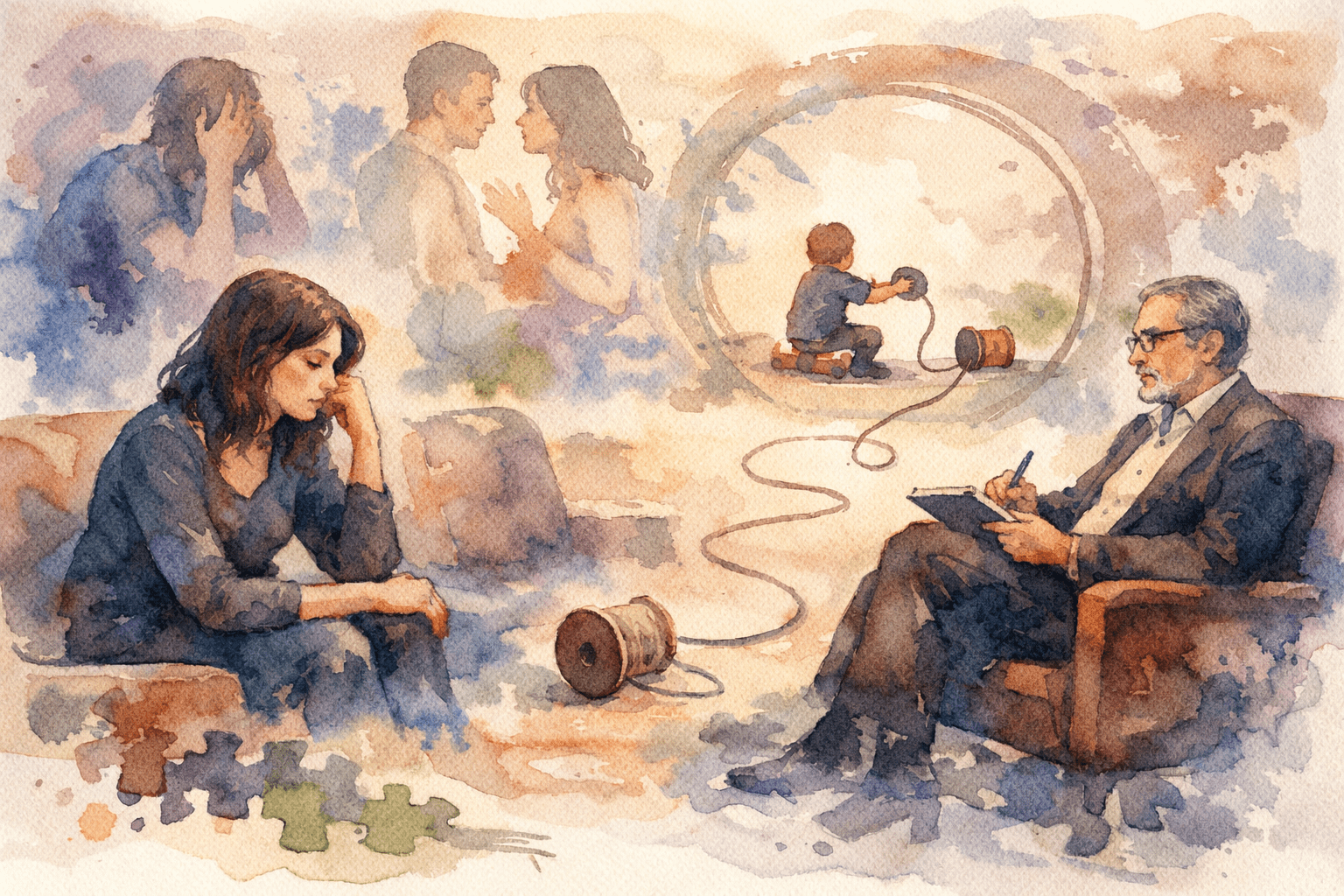
In psychoanalysis and psychodynamic therapy, the therapeutic relationship (if strong enough) becomes a secure base: a consistent, reliable bond where trust can develop. Patterns of avoidance, clinging, or confusion often show up in the therapy room — in transference, the unconscious replay of old dynamics with the therapist. This is why BPG is relationship forcused–we match each of our patients to the best therapist for their needs.
For example:
Rather than pathologizing, these are seen as opportunities to work through old wounds in real time. The therapist’s consistent presence — not abandoning, not intruding — offers a corrective emotional experience.
Over time, this fosters earned secure attachment. Patients begin to internalize the sense of being reliably held in mind, which ripples outward into other relationships.
Other modalities like Emotionally Focused Therapy (EFT) and Dialectical Behavior Therapy (DBT) may also integrate attachment ideas. But psychodynamic therapy uniquely emphasizes unconscious patterns, the deep roots of why we repeat what we repeat.
While therapy offers the deepest transformation, there are everyday ways to nurture more secure attachment:
Attachment theory offers a map of how early bonds shape our emotional lives. But it is not a verdict on who you are. Patterns of anxious, avoidant, or disorganized relating are not character flaws — they are adaptations. And like any adaptation, they can change.
Through therapy, reflection, and supportive relationships, it is possible to grow beyond early templates and create new ways of loving and being loved.
Your past matters. But it does not define the limits of your future.
This article is for general educational purposes only and is not a substitute for psychotherapy, diagnosis, or medical advice. If you are considering therapy, please consult a licensed mental health provider in your area.

Dr. Brian Sedgeley, is a clinical psychologist and the president and founder of Bay Psychology Group, Inc. a psychotherapy and psychological services clinic in Oakland CA.