OCD Treatment: What Psychodynamic Psychotherapy Adds


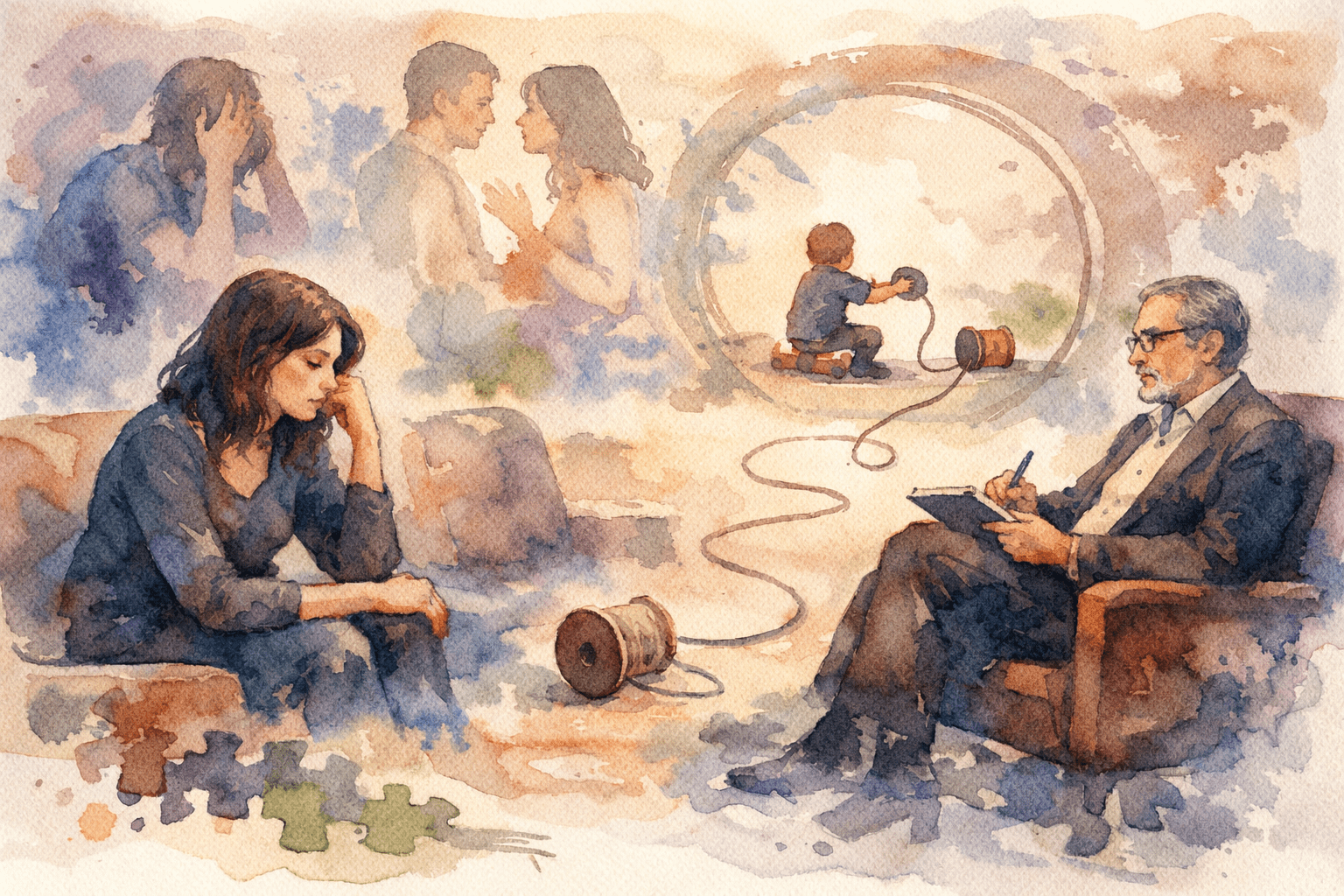
“’If you find your life tangled up with somebody else’s life for no very logical reasons,’ writes Bokonon, ‘that person may be a member of your karass.’”
We often speak of “finding our tribe,” “finding our people,” or of relationships comprised of our “chosen family.” Kurt Vonnegut introduces the term “karass” in his novel Cat’s Cradle (1963), a tenet of his satirical religion Bokonism, which is described in sacred texts containing absurdist spiritual aphorisms written in calypso form (indeed, a form very much appreciated by this writer, but far beyond the scope of this topic). Essentially, a karass is a group of people linked with a metaphysical significance greater than and distinct from friendship or romance whose mysterious bond elevates its members to a higher purpose unknown to the karass itself. There is also a “karass built for two,” or a “duprass.”
Though humorous and somewhat mystical, this concept is uncanny to anyone who has ever fallen in or out of love, been in an “it’s complicated” relationship or “situationship,” or has any passing knowledge of so-called “codependence.” This tangling, the search for internal logic, and the obscure greater meaning strikes a truth at our emotional center. Contemporary psychodynamic theory points us to a more grounded, psychological understanding of this process: we don’t fall in love or partner up randomly. There are reasons we get tangled up with the people we do – we’re just not usually conscious of them. In fact, many of the patterns that draw us toward certain people (and away from others) and keep us circling with them in confusion, passion, excitement, and pain are shaped by deep, internal emotional templates developed in our earliest attachments and core conflicts. It’s as though we’ve met this person before. Psychodynamic couple therapy refers to this as “unconscious couple fit” and offers ways of understanding how and why this factors into our choice of partners.
The concept of unconscious couple fit was introduced by British psychoanalyst Henry Dicks (1967), who identified our unspoken, mutual recognition of aspects of our internal world in another person in order to resolve, contain, challenge, or make contact with them, although we are consciously unaware of doing so (see my earlier blog post for further explanation of the meaning of the “unconscious” to couple therapy). Each of us carries a sort of psychological template shaped by our life experiences (fears, successes, attachments, coping mechanisms, etc.) and has the capacity to pick up on those in others; the people we’re most attracted to, who get under our skin for better or worse, are those whose template complements and resonates with our own. Think the famous (and famously corny) “you complete me” line from Jerry Maguire (1996).
In other words, things like shared hobbies, tastes, or affiliations might consciously attract us to someone, but what really gives a relationship its depth, complexity, and nuance – what makes two people “click” – is this latent or unconscious interaction. How many times have you been on a coffee date with someone who likes all the same music and movies as you but something still feels hollow?
Here is where things get a bit technical. This process, generally speaking, of unconsciously picking up on and responding to qualities of ourselves in another person is known as “projective identification.” This term is famously abstruse and notoriously slippery even for those in the psychotherapy field, and much has been written attempting to explicate it. The concept was first described by Austrian psychoanalyst Melanie Klein in 1946, who thought of projective identification as a “phantasy” (“phantasy” denoting unconscious mental activities as opposed to conscious “fantasy” of imagined scenarios and so forth) of “splitting” off the bad and hated “parts” of ourselves and identifying with them as if they belonged to another person. Why would we do that? Because in doing so the bad stuff now doesn’t belong to me, it belongs to you. Trouble is, we don’t just do this with the bad parts, but with the good parts too. Why would we do that? Because our bad stuff threatens to “contaminate” our good stuff, so we look for another person to “hold onto it” for safekeeping. Think of this whole ordeal as neurotransmitters seeking receptor sites in neuroscience. Or of a small child turning to an adult to make sense of the world or a big feeling.
British psychoanalyst Wilfred Bion (1962) further described the process of projective identification in terms of a “container/contained” process, wherein we project this bad or unbearable stuff into another person (a romantic partner, a parent, a therapist, etc.) who takes it in, processes it, and transmits it back to us in a form that can, theoretically, be tolerated (perhaps goes without saying now but this is all happening unconsciously).
You can imagine how thorny things might get in an intimate partnership when someone we expect to consistently reflect back our good stuff turns out to be a whole other individual person with their own psychic life.
As a brief aside, projective identification is just one example of what are known as “defenses,” described by McWilliams (2011) as various unconscious processes we all deploy some version of to avoid or manage powerful, overwhelming, or threatening feelings and to maintain self-esteem in a manner that is characteristic of our particular personality style.
Couple therapists often refer to “treating the relationship” as opposed to focusing on the individual partners who comprise a couple. Starting from the concept of projective identification noted above, British psychoanalyst Mary Morgan (2019) describes the clinical work of couple therapy as understanding a couple’s entire “projective system,” in a process of clarifying all those things that are unconsciously being split off and identified with, contained and retransmitted, that are unique to each partnership. When this process becomes rigid, defensive, or intrusive, she describes the couple as entering into “projective gridlock” – these “phantasies” about the other partner in the relationship based on one’s own internal templates become somehow fixed, which is often familiar to those seeking couple therapy in terms of what patients or clients call a “communication breakdown,” stonewalling or “the silent treatment,” or of having the same fight over and over again.
Earlier, I described how we seek relationships with those whose psychological “templates” somehow correspond to our own. This is to say we carry an unconscious belief, expectation, or a “phantasy” about who this other person is and how they behave. French psychoanalyst Jacques Lacan (1975) infamously said “there is no sexual relationship,” which isn’t to say couples don’t have sex, but that there is no complete, harmonious, unitary quality between (sexual) partners; desire and enjoyment is borne out of phantasy (or expectations or beliefs) about the other partner. There is always a “split.” In A Couple State of Mind (2019), Morgan references Mattinson & Sinclair’s (1979) evocative examples of some unconscious couple fits, defined through fantasy and projective identification. “In the babes in the wood marriage, both partners defend against anger which is projected outside the relationship, while the couple only express need and yearning between them. In the cat and dog marriage, the couple is caught up in an excited way of fighting together with a denial of more dependent feelings; and in the net and sword marriage, the split is between the couple, one expressing need, the other anger and rejection, but this can easily switch between them.” (p.23)
Because of the unconscious nature of all these processes, couple therapy can be a meaningful and serviceable route by which a relatively “objective” clinician can bear witness to and help couples understand the function of their thoughts, feelings, and behavior – their “projective system.” This allows for feelings and experiences to be understood and communicated rather than “acted out” in the assumptions, “mind-reading,” circular arguments, and stuckness that bring so many couples to treatment. By deeply exploring each partner’s development, expectations, perceptions, and emotional needs, an opportunity is created for newer, stronger patterns of relating based in reality – of who each partner truly is and what each authentically wants and chooses, based on open, emotionally-honest communication.
At Bay Psychology Group, our psychodynamic and couple therapists work with these patterns at their roots—helping partners move from projective gridlock toward more flexible, secure connection. If you’d like a consultation, we can help you decide whether individual or couple work (or both) is the best fit.
This article is for general educational purposes only and is not a substitute for psychotherapy, diagnosis, or medical advice. If you are considering therapy, please consult a licensed mental health provider in your area.
References:
Bion, W. R. (1962). Learning from experience. Heinemann.
Crowe, C. (Director). (1996). Jerry Maguire [Film]. TriStar Pictures.
Dicks, H. V. (1967). Marital tensions: Clinical studies towards a psychological theory of interaction. Routledge & Kegan Paul. (Republished 2014 as Psychology Revivals series) Taylor & FrancisCambridge University Press & Assessment
Klein, M. (1946). Notes on some schizoid mechanisms. In International Journal of Psycho-Analysis, 27, 99–110.
Lacan, J. (1975). Encore: On feminine sexuality, the limits of love and knowledge (Seminar XX, 1972–1973) (B. Fink, Trans.). W. W. Norton. (Original work presented 1972–1973)
McWilliams, N. (2011). Psychoanalytic diagnosis: Understanding personality structure in the clinical process (2nd ed.). The Guilford Press.
Morgan, M. E. (2019). A couple state of mind: The psychoanalysis of couples and the Tavistock Relationships model (The Library of Couple and Family Psychoanalysis). Routledge. PagePlaceUCLA Library SearchTaylor & Francis
Vonnegut, K. (1963). Cat’s Cradle. Holt, Rinehart & Winston.

Dr. Brian Sedgeley, is a clinical psychologist and the president and founder of Bay Psychology Group, Inc. a psychotherapy and psychological services clinic in Oakland CA.