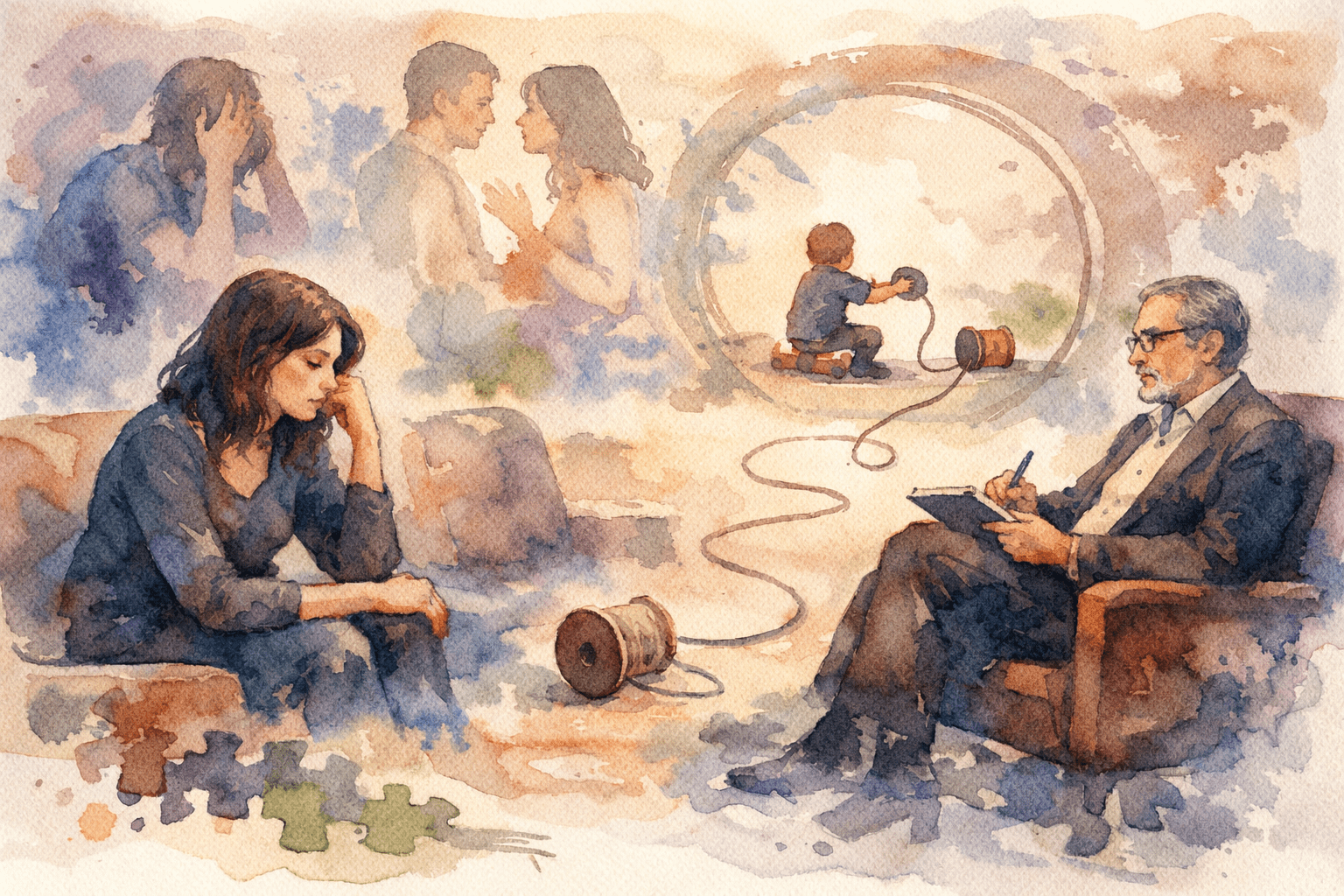
Understanding the Process of Coping with Grief

You might find that your external life is full—a career established, a home maintained, and relationships in place—yet a hollow space remains when the noise of the day subsides. This experience often surfaces as a profound sense of loneliness in midlife, where the shift in roles makes the internal landscape feel suddenly vast or unfamiliar. It is not just about an absence of people; it is about the quality of presence you maintain with yourself.
You may notice that for years, your identity was tied heavily to roles defined by others: a spouse, a parent, or a dedicated employee. As these roles shift and demands change, you might suddenly find yourself facing a silence that feels heavy rather than peaceful. You can feel alone on the inside even with people all around you, and that feeling often marks a turn inward toward a steadier sense of self. It is a slow process of sorting out who you are apart from the jobs you do for everyone else each day.
This transition often creates a complex internal friction because it requires establishing a reliable inner world that exists independently of constant outside validation. You might find yourself questioning who you are when no one is looking or what remains of your desires once the demands of others are stripped away. Psychoanalytic writers call this a “third individuation,” after the separating-out that happens in early childhood and again in adolescence. It involves holding the tension between your long history with others and a growing need to rely on yourself. It is a time to build internal structures that can sustain your well-being even during periods of physical isolation.
When you recognize these moments of interior distance, they offer a window into how deeply you have relied on external mirrors to define your value. In psychodynamic psychotherapy, you can look closely at where your sense of self has become tangled up with what other people expect of you. By untangling these ties, the internal space becomes less of a vacuum and more of a foundational home. Developing a robust internal world means that when loneliness appears, it feels like a temporary condition rather than a fundamental flaw in your character.
As time passes, a specific shift often occurs where the awareness of your own physicality and the passage of time becomes more pronounced. This period brings its own kind of pressure as you face the plain fact that your time is finite. You might find yourself struck by the sudden realization that your time is limited, which can intensify any feelings of isolation. This awareness often forces an evaluation of what truly matters and who remains essential to your inner circle.
This phase asks you to become more comfortable with ambiguity and uncertainty, and to let some questions stay open. You might notice that old habits of seeking constant certainty no longer provide comfort against the reality of aging. Instead of trying to control every variable, this stage invites an acceptance of paradox—the idea that life can be both beautiful and difficult simultaneously. When you stop fighting the reality of time, the pressure to find external distractions to mask these feelings begins to subside.
Confronting these internal tensions is a way to cultivate depth in your daily experience rather than just performing tasks for the sake of completion. You may notice that by acknowledging the fact of mortality, you become more intentional about how you spend your mental and emotional energy. This doesn’t mean accepting sadness as a permanent state, but rather integrating the reality of change into your identity. As you move through this midlife shift, your inner life can become steadier even when outside circumstances are in flux.
There is a significant difference between being alone and having the capacity to be alone. One is a physical state, while the other is a marker of psychological maturity involving your internal resources. You might recognize this when you find that you can sit in a room by yourself without needing to reach for a distraction or seek outside validation. This kind of inner security usually rests on early experiences of being comforted that you carried with you, so that you can offer yourself some of that comfort when no one else is there.
If the thought of being alone feels threatening, it may suggest that your internal resources are currently over-reliant on external people to provide stability. You might find yourself constantly seeking others to fill a void that can only be addressed by building a stronger connection with your own inner life. Developing this capacity means that your sense of self is rooted deeply enough to remain steady even when you are physically solitary. It is about creating an internal landscape where your own company provides a source of nourishment and strength.
When the capacity to be alone is high, your interactions with others become more intentional because they are no longer used as a defense against inner emptiness. You can choose who to spend time with based on genuine connection rather than a need for distraction from yourself. This shift changes how you perceive relationships; they become opportunities for shared experience rather than necessities for survival. Exploring these internal dynamics allows for a deeper exploration of what sustains your sense of peace and satisfaction during the transitions of midlife.
Often, the feeling of being disconnected from others is actually a reflection of an internal conflict regarding how you relate to yourself. You may notice a pattern where you feel invisible in your daily life despite being very busy with practical matters like career and household management. This gap between outward success and inner experience can lead to a sense of stagnation or hidden distress. Identifying these patterns allows you to see how certain defense mechanisms—like over-functioning or intellectualizing—might be keeping your true feelings at a distance.
In this context, addressing loneliness in midlife involves looking at the ways you have historically protected yourself from vulnerability. You might find that by making yourself entirely self-sufficient as a way to avoid being let down, you accidentally built walls that keep others out too. The work lies in identifying these barriers and choosing where to lower them to allow for more authentic connection. It is not about breaking your strength, but about refining it so that it does not serve as a barrier to genuine intimacy.
Another layer involves addressing the repetition of behaviors that no longer serve you but still feel familiar. You might find yourself in cycles of seeking comfort from sources that ultimately leave you feeling more depleted than before. By bringing these patterns into your awareness, you can begin to choose different ways of relating to both the world and yourself. This process allows for a movement toward greater integration, where your internal experience aligns with your outward life, providing a sense of wholeness rather than a performance of it.
What feels like a sudden emptiness in midlife often grows out of long-standing patterns in how you relate to your own inner world. Building the capacity to be alone, and making room for the pressure that arrives with the passing of time, can lead to an inner life that feels both richer and steadier. None of this has to be worked out alone. If these feelings of isolation persist, psychodynamic psychotherapy offers a place to explore where they come from, at your own pace, with someone paying close attention to the patterns you describe and the history behind them. Bay Psychology Group in Oakland provides psychodynamic psychotherapy for adults who are moving through midlife and the changes it brings.
Calvin Colarusso (2005). The Evolution of Paternal Identity in Late Adulthood. Journal of the American Psychoanalytic Association, (53)(1):51-81
D. Winnicott (1965). The Capacity to be Alone. International Psycho-Analytical Library, (64):29-36
Calvin Colarusso (1990). The Third Individuation—The Effect of Biological Parenthood on Separation-Individuation Processes in Adulthood. The Psychoanalytic Study of the Child, (45):179-194
Guillermo Montero (2018). Maturescence: Doorways towards New Insights for a Never Ending Debate about Aging. Romanian Journal of Psychoanalysis, (11)(1):65-92

Dr. Brian Sedgeley, is a clinical psychologist and the president and founder of Bay Psychology Group, Inc. a psychotherapy and psychological services clinic in Oakland CA.