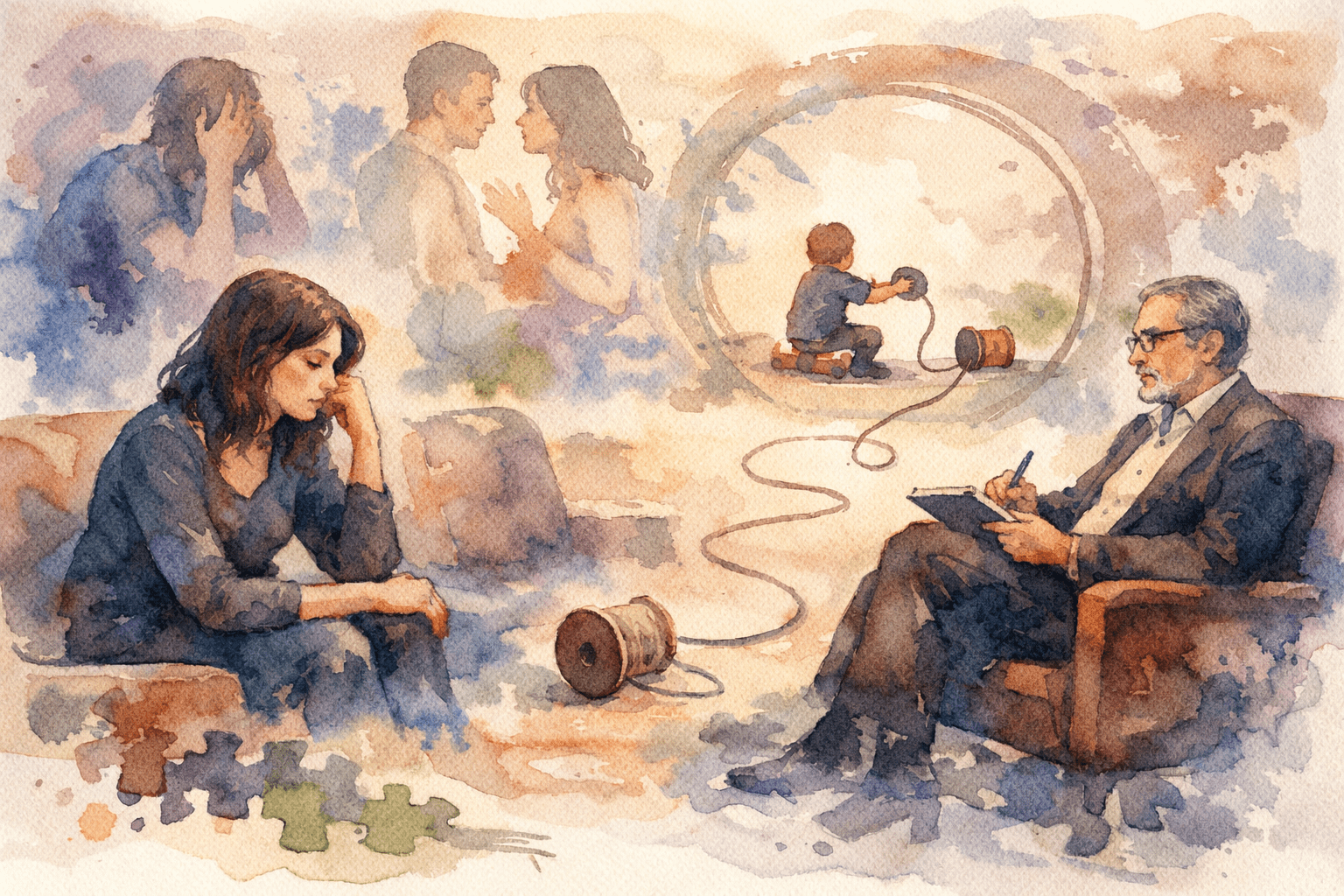
Healing from the Past: A Guide to Trauma Therapy


When a significant person or part of one’s life disappears, the initial shock often feels like a physical weight. You might find yourself moving through daily tasks while feeling strangely detached from your own skin. For many people, coping with grief begins with recognizing these internal shifts and understanding how the mind navigates the sudden absence of what was once constant.
You might notice that at first, the pain feels so sharp it seems impossible to bear in its raw form. In these moments, your mind may create a wall of distance, allowing you to function in your career or social life while the core of the loss remains tucked away. This process of splitting reality from internal feelings of grief is not a failure of character; it is a necessary psychological defense that protects the self (ego) from being overwhelmed by an unbearable truth. By temporarily compartmentalizing the agony, you gain the ability to move through the immediate hours and days without collapsing.
However, this protection can sometimes lead to a state where the mourning process feels stalled or frozen in time. When these internal shields remain firmly in place for months or years, the pain does not dissipate because it is never actually processed by the conscious mind. You might find yourself stuck in a cycle of idealizing what was lost or staying tethered to a version of reality that no longer exists. This lack of movement keeps the psychological growth paused, as the mind chooses safety over the difficult work of integrating the loss into your daily life.
To move through this, you can look at these defenses not as obstacles but as signals. They indicate exactly where the pain is most acute and where the internal narrative remains unfinished. Instead of trying to force a breakthrough, you can observe how these walls protect you while simultaneously keeping you from moving forward into a new reality. When you begin to notice the points where you are intentionally avoiding certain memories or feelings, those are the exact locations where the work of integration begins. This process requires patience to move from a state of protection to a state of integration.
Loss is rarely just about the external person or object that is gone; it often involves a fracture in how you perceive your own identity. You might feel as though a part of yourself—a certain capacity for joy, a specific way of dreaming, or a sense of security—has vanished along with the thing you lost. When this happens, the grief is not only about someone else’s absence but also about the mourning of a version of yourself that felt whole. This internal collapse can feel like a profound loss of self-worth or a sudden drop in your own psychological stability.
This experience often manifests as a feeling of being haunted by who you used to be before the transition occurred. You might struggle to find motivation because the person who possessed that drive no longer feels present within your current consciousness. In these moments, the mourning is for the ‘personality death’ that occurs when a primary pillar of your life is removed. It is common to feel like a stranger in your own body as you navigate this internal void and try to figure out what remains of your core identity.
Integrating this loss means acknowledging that the person who existed before the loss cannot be simply replaced, but they can be incorporated into a new sense of self. You are essentially trying to build a new architecture for your internal life while using the remnants of the old one. This process involves slowly weaving the memory of what was lost into the fabric of who you are today. It requires a slow, deliberate acknowledgment of how your identity has shifted and a commitment to constructing a new sense of self that carries both the loss and the growth it demanded.
Sometimes the nature of what is lost creates a unique kind of friction in the mourning process. You might find yourself struggling to move forward because the object of your grief still occupies a physical space in your life, even if it has been fundamentally altered by illness or disability. This creates a sense of ambiguity where the person is present but the relationship has shifted into something unrecognizable. Such situations often result in a complicated state of mourning where the mind struggles to reconcile the presence of the body with the psychological absence of the former dynamic.
This specific type of loss can trigger an unsettling feeling because it does not fit standard narratives of bereavement. You might find yourself caught between wanting to hold onto the past and needing to accept the current reality, leading to a sense of profound uncertainty. The brain has difficulty categorizing this experience as a simple ‘gone’ or ‘here,’ which can leave the mourning process stalled in a gray area. In these cases, processing loss involves finding a way to settle into the reality of the change while honoring the history that preceded it.
Another complexity may arise when pre-existing habits of thought—such as always viewing others as perfect—interfere with your ability to feel your own frustrations or complexities regarding the loss. If you have spent years avoiding feelings of anger or doubt, those emotions may resurface only to be suppressed by your internal defenses. Moving forward requires a willingness to experience these nuances rather than shielding yourself from them. By allowing yourself to see the complexity of what was lost, you can begin to move through the mourning process and may find a sense of peace in a new reality.
True progress in coping with grief involves moving toward a state where the loss is no longer an acute rupture, but a part of your lived history. This transition requires what some call decathexis—the process of untangling your internal sense of self from the thing that was lost. It means that while you will always carry the memory of what happened, it no longer consumes the entirety of your mental energy. You begin to function not by ignoring the loss, but by integrating it into a broader narrative of the life you are still living.
This integration is evidenced when you can think about the past without feeling like you are being pulled back in time every single moment. It involves finding a way to exist in the present while acknowledging that your presence here was shaped by what is no longer there. You might notice this shift when memories begin to feel more like landmarks rather than traps. The goal is not to forget, but to weave the experience into the fabric of your identity so that it becomes part of the foundation upon which you build your future.
This process takes time because it involves a fundamental re-organization of how you perceive the world and your place within it. It requires patience with yourself as you move from the sharp edges of immediate pain to the smoother textures of long-term integration. You are essentially rewriting the inner map of your life, marking the areas where things changed and building new paths over them. As these pathways become more familiar, the constant noise of the loss begins to settle into a quieter hum, allowing you to inhabit your current reality with more clarity and presence.
The path through profound loss is rarely linear; it often involves periods of retreat followed by moments of new understanding. Whether the source of pain is the sudden absence of a loved one or a significant change in your own physical or professional life, the process requires a patient exploration of how those changes have impacted your internal world. You may find that much of the work lies in moving past protective defenses to honestly acknowledge the loss of pieces of yourself that felt essential to your identity. For many people, coping with grief is an ongoing endeavor of integration rather than a destination you reach quickly. If you are seeking support as you navigate these complexities, professional guidance can provide a structured way to explore these inner layers. This commitment is available at Bay Psychology Group in Oakland.
Harold Blum (2003). Psychic Trauma and Traumatic Object Loss. Journal of the American Psychoanalytic Association, (51)(2):415-431
Channing Lipson (1963). Denial and Mourning. The International Journal of Psychoanalysis, (44):104-107
León Grinberg (1978). The ‘Razor’s Edge’ in Depression and Mourning. The International Journal of Psychoanalysis, (59):245-254
Carolyn Feigelson (1993). Personality Death, Object Loss, and the Uncanny. The International Journal of Psychoanalysis, (74):331-345
Kenneth Thomas & Jerome Siller (1999). Object Loss, Mourning, and Adjustment to Disability. Psychoanalytic Psychology, (16)(2):179-197
Moses Laufer (1966). Object Loss and Mourning During Adolescence. The Psychoanalytic Study of the Child, (21):269-293
We help people navigating anxiety, identity concerns, relationship strain, and emotional burnout—especially those who often carry a lot without letting it show. If you’re looking for something deeper than surface-level fixes, psychodynamic therapy might be right for you.

Dr. Brian Sedgeley, is a clinical psychologist and the president and founder of Bay Psychology Group, Inc. a psychotherapy and psychological services clinic in Oakland CA.