
OCD Treatment: What Psychodynamic Psychotherapy Adds

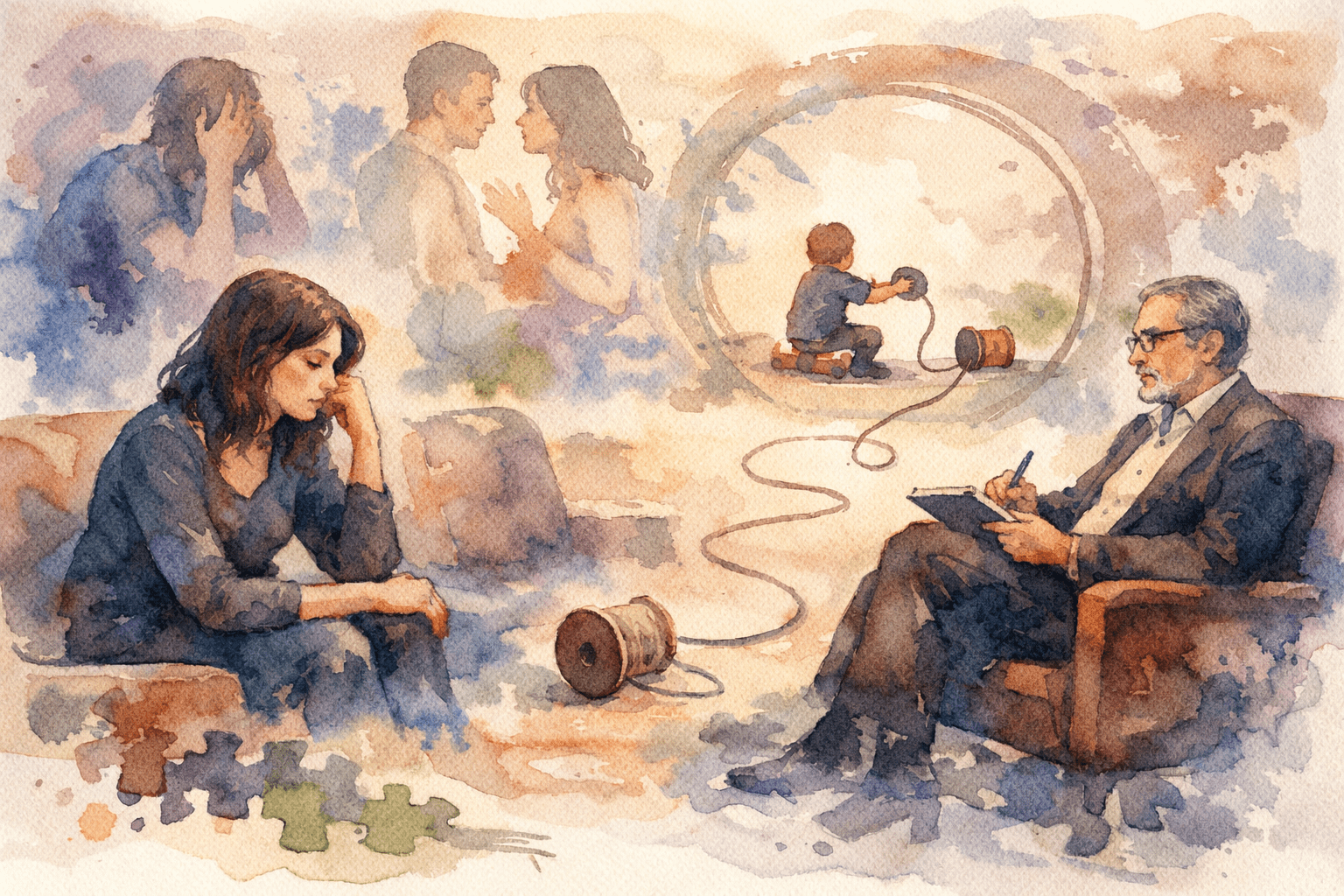
“Why do I keep repeating the same patterns?” By the time people start asking this question, they are rarely confused about what keeps happening. They can describe the pattern with painful precision. Different partner, same emotional confusion. Different breakup, same hollow aftermath. Different stage of life, same feeling of watching themselves do the thing they had sworn not to do again.
That is why so much advice about “making better choices” falls flat. It assumes the problem is mainly conscious. It assumes that if people understood what they were doing, they would stop.
Psychodynamic therapy starts from a less flattering and more useful premise. Many of the patterns that govern adult relationships are not simply choices. They are unconscious repetitions.
Freud’s first major insight on this point was clinical, not speculative. He noticed that patients did not mainly recover the past as a clear memory. They relived it. They brought it into the present in the form of moods, expectations, conflicts, and ways of relating. What had not been worked through returned, not as history, but as a live process (Freud, 1914/1958).
That is still one of the central claims of psychodynamic therapy. If you keep ending up in the same kind of relationship, the question is not only why you chose this person. The deeper question is what pattern of feeling, expectation, and conflict is being repeated through this person.
In Remembering, Repeating and Working-Through, Freud described a problem that remains instantly recognizable in clinical work. Patients do not necessarily recall what has been repressed in a straightforward way. They enact it. The old conflict appears in behavior, tone, timing, resistance, and relationship. Instead of saying, “I was defiant toward my parents,” the patient becomes defiant with the therapist. Instead of remembering shame, the patient becomes ashamed of being in treatment. Instead of describing a helpless dead end, the patient recreates one in the room (Freud, 1914/1958).
This is what makes repetition so hard to recognize from the inside. It rarely arrives feeling like repetition. It arrives feeling current, justified, and specific to the person in front of you. It feels like this partner, this disappointment, this insult, this abandonment.
But from a psychodynamic point of view, the present situation is often carrying more than the present situation. It is saturated with older meanings.
Repetition compulsion is not some narrow technical idea confined to psychoanalysis, it is one of the basic ways human beings organize their emotional lives (Corradi, 2009). People repeat modes of defense, object relations, self-judgment, and coping that were forged early and then consolidated over time. That is true of adaptive repetition as well as maladaptive repetition. We repeat what formed us, for better and for worse.
This is the question that makes the whole issue more than a description. If people are organized to seek pleasure and avoid pain, why do they so often return to precisely what injures them?
Freud sharpened that question in Beyond the Pleasure Principle (1920/1955). By that point he had concluded that repetition could not be explained simply by the search for pleasure. There is, he argued, a compulsion to repeat that persists even when the repeated experience is painful.
His most famous illustration is the fort-da game. Watching his young grandson throw a spool away and retrieve it over and over, Freud interpreted the game as an attempt to master an emotionally difficult experience: the mother’s comings and goings. The child could not control the original loss. In play, he could stage it, reverse it, and take an active position in relation to it (Freud, 1920/1955).
That remains a powerful way to think about adult repetition. The repetition is not random. It is not merely self-sabotage in a superficial sense. It often represents an effort—usually unconscious—to master, repair, reverse, or survive something that was not metabolized when it first occurred.
Corradi (2009) gives this clinical precision. He argues that maladaptive repetitions are often reparative, retributive, or restorative. A person may go back, again and again, to some version of the old scene in an attempt to get it right, get even, or finally get what was missing. None of those efforts has to succeed in order for the repetition to continue. In fact, they usually fail, which is why the cycle remains alive.
That is why people so often feel trapped between insight and compulsion. Consciously, they know the outcome is familiar and bad. Unconsciously, they are still trying to solve an old problem with new people.
One of the more deceptive features of repetition is that it rarely announces itself as repetition. It feels like attraction. It feels like intensity, chemistry, recognition, inevitability. People say, “I just clicked with them,” even when the relationship later reveals a familiar pattern of deprivation, volatility, or self-erasure.
Part of the problem is that the mind does not reliably distinguish between familiar and safe. Early emotional life establishes expectations about closeness, need, dependence, frustration, criticism, idealization, and loss. Those expectations do not disappear because we outgrow childhood. They become the background against which adult relationships are felt and interpreted.
So the familiar can acquire the force of the compelling. Conditional love can feel like real love. Uncertainty can feel like depth. Emotional distance can feel like the price of attachment. Reassurance can even feel thin or unconvincing if what one recognizes as intimacy is struggle, vigilance, and intermittent reward.
Repetition is universal: people replay emotionally meaningful ways of relating, and some of those repetitions are adaptive and rewarding. The point is not that all familiarity is bad. The point is that painful familiarity often masquerades as truth (Corradi, 2009).
That is what makes relationship patterns so stubborn. They are not just errors in judgment. They are organized expectations about what relationships are.
It is easy to talk about repetition as though it were something sealed inside the person. That is only half right. Repetition becomes visible because it gets enacted with actual people.
Corradi (2009) gives the everyday example of couples who enter the same provocation and counter-provocation sequence over and over: each knows exactly which button to push, each elicits the response expected from the other, and the conflict unfolds with almost mechanical predictability. The script is familiar, the escalation is familiar, and even the aftermath is familiar.
This matters because it corrects a common misunderstanding. Repetition is not just a private mental residue. It is a relational process. A person brings expectations, fears, and defensive habits into the interaction; the interaction then confirms and entrenches them. The loop stays alive because it is lived.
A person who expects criticism may become guarded, combative, or self-effacing in ways that invite misunderstanding. A person who assumes their needs will not be met may suppress them so completely that others have little chance of responding. A person who cannot tolerate dependence may move toward closeness and then abruptly create distance. The pattern is not just remembered. It is co-produced in the present.
That is unsettling, but it is also where leverage exists. If the pattern is happening now, it can be observed now.
Many people come to therapy already quite articulate about their history. They know their father was emotionally unavailable. They know their mother’s anxiety became their own. They know they tend to pursue people who withhold and distrust people who are straightforwardly available.
And still the pattern continues.
Freud was explicit about this. Naming the resistance does not dissolve it. On the contrary, resistance often intensifies once it has been identified. The patient has to become more familiar with it, encounter it repeatedly, and gradually work through it (Freud, 1914/1958). That is what working-through means. Not a flash of understanding, but sustained contact with the same material until it loses some of its inevitability.
Loewald (1971) helps explain why this is so difficult. He argues that repetition is not merely mechanical reiteration. The crucial distinction is between repetition as passive reproduction and repetition as active re-creation. In passive repetition, prior experience is simply reproduced in action, affect, or relationship. In more active forms of psychic work, the old experience can be reorganized and taken up differently.
That distinction clarifies why insight can be real and still insufficient. A person may understand the map and still be living inside the territory. They may be able to describe the pattern and yet continue to reproduce it automatically. The task of therapy is not merely to add information. It is to shift the person’s relation to what is being repeated.
Psychodynamic therapy matters here because it does not treat the pattern as something that exists only outside the session. It assumes that if a person has a characteristic way of organizing relationships, that organization will emerge with the therapist too.
This is transference.
Freud’s formulation still holds: transference is not an accidental side effect of treatment. It is one of the main ways the patient’s conflicts become clinically available (Freud, 1914/1958). What has been repressed returns in relation to the therapist, not because the therapist resembles the original figures in any literal sense, but because the patient’s internal organization is active and looking for a field in which to repeat itself.
Corradi (2009) makes an important refinement. Transference is “only a piece of repetition,” not the whole story. That is, it matters precisely because it provides an in-vivo sample of what is happening in the person’s life elsewhere. The point is not to become fascinated with the therapy relationship for its own sake. The point is to use what appears there to understand the broader pattern.
This is where Betty Joseph sharpens the whole picture. In her paper “Transference: The Total Situation,” she argues that transference is not just what the patient explicitly says or feels about the analyst. It is the whole situation being created in the room: how the patient uses the analyst, how the interaction is being organized, what pressures are exerted, what feelings are stirred up, and what defensive system is quietly being enacted (Joseph, 1985).
That is a much more demanding view of therapy than the popular caricature of transference as simply “you see your therapist as your parent.” Joseph’s point is that something is always happening in the relationship. The patient is not just reporting on their world. They are bringing it. They are reproducing it. And they may unconsciously pressure the therapist to occupy a role within it.
That pressure matters. Joseph (1985) emphasizes that the therapist’s emotional response—countertransference—is not just noise to be eliminated. It can be a source of data. Patients may draw the analyst into confusion, rescue, impatience, pseudo-understanding, compliance, or helplessness. If the therapist notices this carefully enough, what becomes visible is not merely content but organization.
This is one of the hardest ideas to communicate outside the consulting room, but it is central. The patient does not only say what happened to them. They often create, in miniature, the kind of emotional world they are used to inhabiting.
Once repetition becomes visible in the room, the work changes. The pattern is no longer only being described after the fact. It is occurring. That makes it available for interpretation, recognition, and gradual reorganization.
Freud called the consulting room the place where repetition can assert itself with relative freedom and therefore become workable (Freud, 1914/1958). Joseph (1985) shows that this work depends on attending to the whole relational field rather than only to declared content. Corradi (2009) stresses that the therapist must actively bridge what appears in transference to the patient’s real-life repetitions. And Loewald (1971) gives the most useful formulation of what successful treatment changes: repetition begins to shift from passive reproduction toward re-creation.
The person becomes less governed by automatic replay. They may still feel the pull of the old pattern, but there is more room between thought and action, feeling and enactment. They can notice the old script without entering it immediately. They can bear affects that previously had to be discharged through repetition. They can begin to experience current relationships as current, rather than as disguised continuations of older ones.
That is why psychodynamic change often looks less dramatic than people expect, but is deeper than it first appears. It may show up as a pause, a doubt, a refusal to take the bait, an ability to tolerate steadiness, or a less urgent need to force a familiar emotional outcome. Those are not small things. They represent a different organization of experience.
Psychodynamic therapy is often assumed to lack empirical support, but that assumption is not accurate. A large meta-analysis by Shedler (2010) found that effect sizes for psychodynamic therapy are comparable to those of other empirically supported treatments. More importantly, the gains from psychodynamic therapy tend to persist and, in some cases, increase after treatment ends. This pattern is consistent with the kind of structural change described above, where the focus is not only on symptom reduction but on altering the underlying organization of experience.
There is a tendency in contemporary mental health writing to move too quickly from recognition to instruction. Set better boundaries. Choose differently. Stop chasing unavailable people. Ask for what you need.
None of that is wrong. None of it reaches far enough on its own.
If the person is still organized around the same pattern of expectation and defense, new advice is often absorbed into the old structure. Even “healthy” language can become another way of repeating the same conflict.
The harder and more useful premise is this: if you keep ending up in the same kind of relationship, you are probably not merely making the same mistake. You are repeating a way of organizing intimacy, frustration, dependency, and selfhood that feels familiar because it was built early and reinforced often.
Psychodynamic therapy is built for exactly that problem. It does not ask only what happened to you. It asks what is still happening, how you help keep it alive, how it appears in the therapy itself, and what would have to change for the repetition to lose its grip.
Everyone repeats. The issue is not whether repetition exists. The issue is whether it remains automatic, punitive, and invisible, or whether it becomes something that can be recognized, worked through, and reorganized.
Freud identified the basic fact that people repeat what they cannot yet fully remember as past (Freud, 1914/1958, 1920/1955). Corradi (2009) showed how broadly this applies to real clinical life, not just the consulting room. Joseph (1985) clarified that the pattern appears in the total situation of the therapeutic relationship, including how the patient uses the analyst. Loewald (1971) made the crucial distinction between passive reproduction and re-creative repetition, which is where real change begins.
If you keep finding yourself in variations of the same relationship, the task is not to lecture yourself into better choices. The task is to understand what is being repeated, how you participate in it, and what kind of work would be required for something genuinely different to become possible.
That is not a quick fix. It is a more serious kind of hope.
Freud, S. (1955). Beyond the pleasure principle. In J. Strachey (Ed. & Trans.), The standard edition of the complete psychological works of Sigmund Freud (Vol. 18, pp. 7–64). Hogarth Press. (Original work published 1920)
Joseph, B. (1985). Transference: The total situation. International Journal of Psychoanalysis, 66, 447–454.
Loewald, H. W. (1971). Some considerations on repetition and repetition compulsion. International Journal of Psychoanalysis, 52, 59–66.
Shedler, J. (2010). The efficacy of psychodynamic psychotherapy. American Psychologist, 65(2), 98–109.
We help people navigating anxiety, identity concerns, relationship strain, and emotional burnout—especially those who often carry a lot without letting it show. If you’re looking for something deeper than surface-level fixes, psychodynamic therapy might be right for you.

Dr. Brian Sedgeley, is a clinical psychologist and the president and founder of Bay Psychology Group, Inc. a psychotherapy and psychological services clinic in Oakland CA.