Loneliness in Midlife: Why It Happens and What It Means


Few questions in modern therapy spark as much debate as one: “Why do I repeat the same relationship patterns?” It is a deeply personal and often frustrating realization for many people navigating the complexities of dating and intimacy. You might find yourself meeting the same type of person over and over, experiencing the same conflicts, or ending up in familiar emotional deadlocks. Understanding these cycles requires looking beneath the surface of your current choices to see what is driving them.
When we find ourselves stuck in repetitive cycles, it is often a way to manage overwhelming internal feelings like anxiety or depression. By choosing a familiar dynamic—even one that causes pain—the mind creates a sense of predictability in an unpredictable world. This behavior acts as a shield against the discomfort of facing deep-seated fears. Instead of navigating the unknown, we settle into what we already know, even if what we know is hurting us.
This repetition often serves as a defense against feelings that feel too intense to process alone. For many, the prospect of true emotional dependence can feel terrifying or overwhelming at any given moment. By repeating a familiar pattern, you are essentially staying in a ‘stalled’ internal state where things feel manageable. It is less about choosing a bad situation and more about trying to manage an unbearable internal emotion through the safety of the known.
In psychoanalysis, this can be viewed as a complex mix of instinctual habits and conscious ego defenses. You might not consciously choose these patterns, but your psyche utilizes them to avoid confronting raw emotions that feel threatening. By staying within the loop of familiar dynamics, you create a psychological buffer. This allows you to navigate daily life without having to face the full weight of underlying anxieties regarding intimacy and vulnerability.
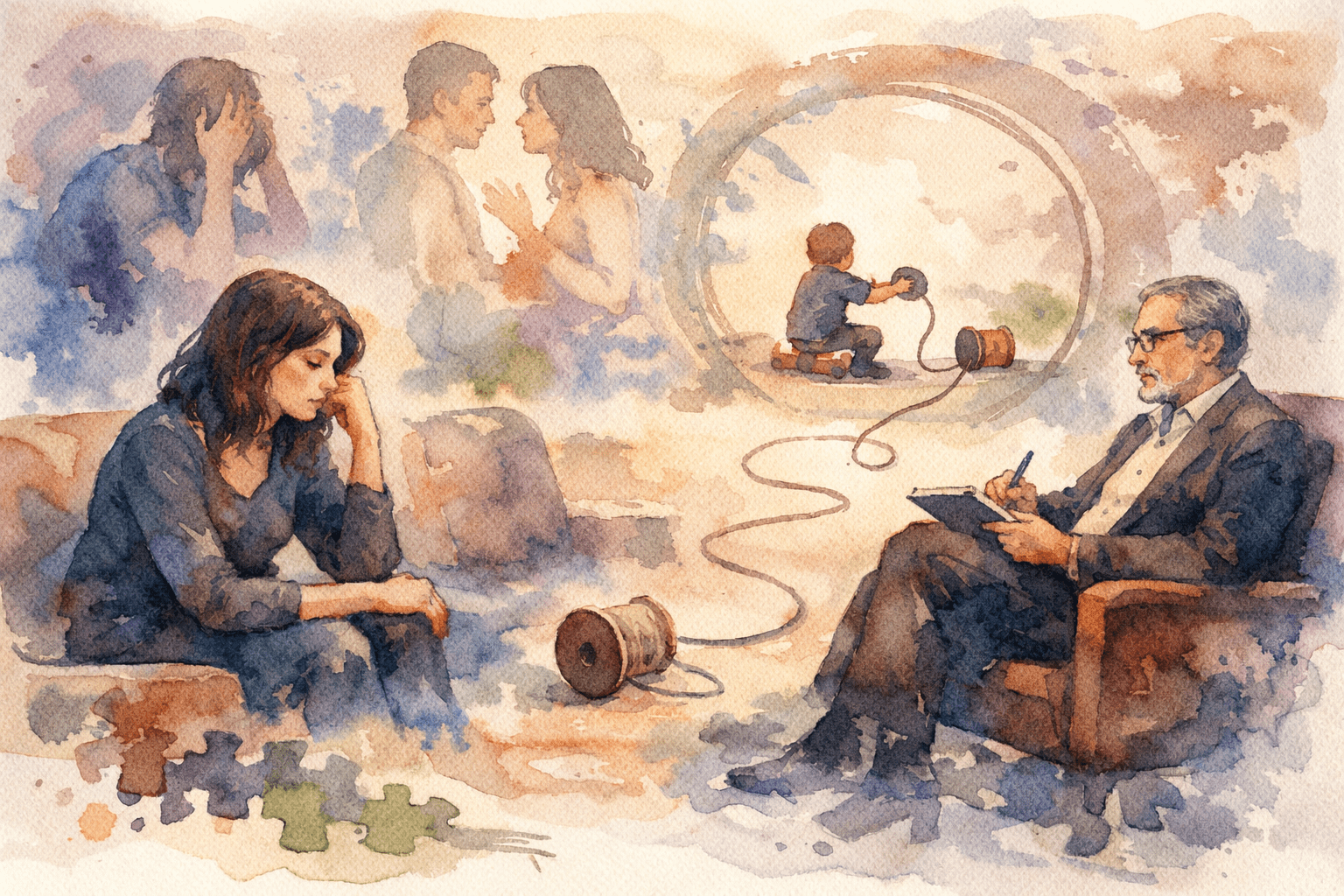
One reason we experience these recurring cycles is through a process called transference. This happens when we unconsciously project past experiences with significant figures from our history onto the people in our current lives. When you meet someone new, your mind may automatically cast them in a role they haven’t chosen to play. Consequently, you begin to react to them based on memories rather than their actual personality.
Transference turns the past into a present reality, making it feel as though you are living out an old script in a new setting. This can lead to significant confusion because your reactions may seem disproportionate or inconsistent with the current situation. You aren’t just reacting to the person standing in front of you; you are reacting to the ghost of a previous relationship. This makes it difficult to see your current partner clearly, as they are clouded by these historical overlays.
It is important to note that different clinicians may offer varying interpretations of how this process unfolds for each individual. Because everyone’s history is unique, the way the past influences the present varies from person to person. However, identifying where the old script ends and the current reality begins is a vital step for new relationships patterns to emerge. By recognizing these moments of transference, you can begin to ground yourself in the present moment rather than reacting to a reflected past.
It is helpful to view these repetitive behaviors not as personal failures, but as survival strategies. These patterns are often adaptations developed early in life in response to challenging environments or significant trauma. What feels like a ‘broken’ cycle today was actually an effective way to keep you safe in the past. Your brain learned what it took to survive your circumstances and hard-wired those responses into your subconscious.
These internal scripts were designed to maximize your safety during formative years when you might have felt vulnerable or threatened. When these behaviors persist into adulthood, they continue to function as protective mechanisms even if they no longer serve you well. You are not choosing ‘bad’ patterns; your psyche is following a roadmap created for protection. Recognizing this can change the way you view yourself from someone who is failing to someone who has been trying to protect themselves.
Because these behaviors were once necessary, they are deeply ingrained in your psychological makeup and are not easily discarded overnight. The line between internal defenses and external systems can sometimes be blurred, making it hard to see where the survival instinct ends. When you work through these patterns, you aren’t just changing a habit; you are updating an old system. You are teaching your mind that the environment has changed and that new, healthier ways of relating are now safe for you.
Breaking a cycle requires recognizing the moment when an old survival strategy becomes a modern hindrance. When you begin to see these patterns as defensive maneuvers, the shame associated with them begins to lift. You can start to look at your history with curiosity rather than judgment. This shift allows you to explore why certain behaviors became your default mode and how they continue to influence your daily interactions.
The goal of exploring these themes is not just to understand the ‘why’ but to create space for something different. By identifying where transference is occurring, you can start to notice when a reaction is coming from a past wound rather than a current fact. This awareness provides a crucial buffer zone between an impulse and your next action. It gives you the opportunity to pause and choose a response that aligns with your current desires.
Every person’s process through these patterns is unique, and the pace of change depends on individual needs and history. By working within a therapeutic framework, you can slowly deconstruct these deeply ingrained scripts. You move from reacting automatically to responding intentionally in your relationships. This process allows for the development of new ways of connecting that feel authentic to who you are today. Ultimately, you learn to replace old defenses with genuine, safe intimacy.
Understanding why you might find yourself repeating certain relationship patterns is a profound step toward personal growth and change. At Bay Psychology Group, we believe that these cycles aren’t simply signs of ‘brokenness,’ but are often complex layers of survival, protection, and history. By exploring the underlying causes—whether they be defensive maneuvers against anxiety, the lingering echoes of past relationships, or ingrained survival instincts—you can begin to untangle these threads. Our approach in Oakland focuses on uncovering these deep-seated scripts so that you can feel more present and capable in your current life. If you are ready to explore these patterns and find new ways to connect authentically with others, we invite you to reach out for a consultation.
Betty Joseph (1959). An Aspect of the Repetition Compulsion. The International Journal of Psychoanalysis, (40):213-222
Harold Stewart (1987). Varieties of Transference Interpretations: An Object-Relations View. The International Journal of Psychoanalysis, (68):197-205
Edward Bibring (1943). The Conception of the Repetition Compulsion. The Psychoanalytic Quarterly, Psychoanal. Q., (12):486-519
Daniel Morehead (2002). The Repetition Compulsion and Object Relations: An Evolutionary Hypothesis. Psychoanalytic Psychotherapy, (25)(3):247-279
Charlotte Kahn (1987). Object Relations: A Dynamic Bridge between Individual and Family Treatment. Psychoanalytic Review, (74)(3):427-429
We help people navigating anxiety, identity concerns, relationship strain, and emotional burnout—especially those who often carry a lot without letting it show. If you’re looking for something deeper than surface-level fixes, psychodynamic therapy might be right for you.

Dr. Brian Sedgeley, is a clinical psychologist and the president and founder of Bay Psychology Group, Inc. a psychotherapy and psychological services clinic in Oakland CA.